


"The Diary," a father-daughter play for the ages, tells another Anne Frank story


There’s a moment in “The Diary,” a new play by Theater for the New City playwright in residence Claude Solnik, that says something very much worth remembering. In this story, we follow Otto Frank (Charles E. Gerber), the now famous father of Anne Frank (Eva Gozé), and see Anne, in his mind and memory. Miep, played by Patricia Magno, gives Otto Anne’s diary that she picked up after their arrest.
“You need to promise Anne you’ll make her voice heard,” Magno as Miep, one of the play’s heroes, pleads.
Berger, whose Otto is almost as much of a hero as Anne herself, pauses before answering, a tormented moment where he is, it seems, deciding what to do. There are moments that matter. This is one of them.
“The only promises that matter are the promises we keep,” Berger replies.
“Promise her,” Magno as Miep continues. “Promise yourself, promise me.”
What follows in this production, at Theater for the New City, is another Anne Frank, and Otto Frank, story, about a kept promise, a father-daughter play about how Otto takes a diary, at that time a private pile of pages, and helps it become one of the world’s best known, and most loved, books. Even getting it read, to say nothing of published, pushinsg for a book by a girl when publishing was a particularly patriarchal industry, is a challenge. And yet, it not only gets published, but becomes a sensation. How did that happen? Solnik’s play seeks to answer and largely succeeds, finding drama in the discovery and advocacy for the diary in this well written, acted and staged show.
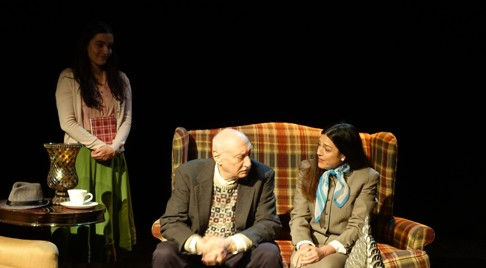
Ably directed by Deborah Rupy, who also plays Edith Frank with humanity, with help from assistant director Joanna Newman, this production presents an important, new play and story that, I believe, is deserving of, and I hope receivese, more productions. Eva Gozé’s portrayal of Anne (she also looks quite a bit like Anne) gives us a very human rendition of young girl who is also a sort of wise child.
The production shows us Charles E. Berger embodying Otto’s struggles about what to do with the book as a kind of Hamlet after the Holocaust paralyzed by decisions, whether to edit, who to publish, and how to advance. Amid PTSD after the war (he too was in a concentration camp), Berger as Otto finds a cause, meaning and mission. We also see Gozé (who is Dutch, the program notes) as Anne and Peter (Hugo Persson), trapped in the attic as the pages come to life while Berger reads them.
The whole family, in fact, comes back to life, including Anne’s older sister Margot (Gabi Schwartz) and Peter (Persson) as Otto reads the diary. Gozé gives us an Anne who is at once fragile and forceful, playful and passionate, and yet serious and perceptive. She escapes daily from the attic with words. It’s as if Solnik, in this production with a European feel, is playing three dimensional chess, as we see Anne looking over Otto’s shoulder as he decides what to do. Rupy’s direction shows us not ghosts – Margot, Edith, Anne and Peter – but psychological shadows, half angel and half human, watching the present take place.
While Anne Frank’s diary itself is well known, this play tells a little known story of how that diary became known, against all odds. The set design itself creates one world with long bookshelves, each designed differently, showing past, present and future linked. It all blends as memory and the present mix. Gabi Schwartz as Margot and Anne are sisters, dealing with daily rivalries and trivial battles. Hugo Persson as Peter and Eva Gozé as Anne share affection, even a kiss. It’s touching when Gozé says she likes to look at things and count to ten to remember them, burning them into her brain and memory, as if she understands each perishable moment is gone forever unless you write it down, defeating death as the diary one day well.
Rupy as Edith and Gozé show us a a heartfelt mother and daughter, each longing for love in their own way, as Anne seeks courage and her mother loses hope. In the end, this is a play about many things, including how hope survives, as well as a daughter and father and daughter and mother. Rene Sambrailo plays a young man who understands the significance of what he sees. He is intense, forceful, with a searing stare, and we know the book has touched his heart, the highest level of connection with literature. And this play, as well as the performances, touch our hearts.
We see Otto and Miep as they seek to save Anne’s words, meeting editors, played by Laura Jones and then Karen Freer and hearing about horrible, critical editors who don't "get" it. The book isn't about concentration camps, so what is the point? But Jones and Freer as encouraging editors both “get” the diary and its importance. This play, though, is about far more than publication. We also see the parallel story with Anne in the diary rebelling against her mother, challenging the most important woman in her life and a rival for her father's affections.

Some of the most moving scenes involve Gozé as Anne, Abby Schwartz as her sister Margot and Peter played by Hugo Persson. They live in the moment, enjoying life even though we know it will be over too soon. Gerber provides a powerful portrayl of Otto as an ambivalent father, recognizing his daughter is a wonderful writer, but realizing he never got to know her. Was that his fault? She comes to life each night that he reads from the dairy, only for him to lose her again and again when the dream disappears. Patricia Magno as Miep shows us a grounded, strong, caring person, wise, practical and heroic. She remains rational, while Gerber’s Otto is caught in an emotional maelstrom, not sure what to do. It’s not about a book, she understands, and soon he does too. It’s about taking Anne’s words and giving them and her new life, breathing life back into her.
The thing that makes the play so strong is this struggle is about so much more than a book, and the stakes are so much higher. It is a father and daughter story about a father who fights hard to make his daughter’s voice heard, a promise kept, even if he never really heard that silent voice concealed in writing. Anne talked instead to “Kitty,” the ideal reader, in the diary. We watch Berger, as Otto, fight not simply to realize his daughter’s audition, to become an author, but seeking to save her. Gozé as Anne, in his mind and memory, watches her father’s struggle and gets involved. She never got to see her book’s journey, in real life, but The Diary lets Anne see her trip to America. Marsh Shugart's lighting conveys a sense of the past, as well as the bright light of the present. Matthew Seepersad operated the board, gliding from bright light to more forbidding and foreboding.
In one of the most moving moments, we see Gozé facing the audience, seated alone, as if in a spotligh, talking to us, as we realize she is trapped, yet a free spirit. Her hope, her optimism, her words all sail into the air far beyond the confines of the attic, with its tree nearby. We know her words, not swallowed up by air, will never be destroyed, in the book, even if she will die terribly young. She will become not only an author, but a great author, or maybe she already is. Scenes between Rupy and Gozé also are powerful, as they fight, feud and show friendship. There’s a moment when Rupy scores a kind of point against Gozé. She smiles with satisfaction. Yes, her daughter is smart, but so is she. They draw closer in that competition.

Otto’s struggle shows us how a father must feel at once realizing he never got to know his daughter, and realizing that only after her death, he is meeting her over again. But in The Diary, this is more than a metaphor as we see this meeting take place and the relationship evolve. We see Berger as Otto deal with the difficulties of seeing his daughter’s words, when she is gone with Magno's Miep as a kind of rock, quiet, stable, stubborn and strong yet sensitive. He understands that he is meeting his daughter as he gets to know her as a young adult. But he also understands that the words don’t bring Anne back. At first he isn’t sure whether he should even try to publish the diary. It’s a private document, on the one hand, critical of his wife. He needs to protect Anne ,but also the family.
We see what happens when the diary reaches stranger's hands, editors, who react differently. Femalel editors love it, while men condescend, criticize and kill the book. Laura Jones portrays an editor (and a relative) who is encouraging, as women move the story and publication forward. But Karen Freer as Judith Jones, a famous editor, carries the book heroically into the stratosphere, a kind of ideal reader after her first “reader" trashes the book in a report that Otto and Anne get to see. Cameron Reilly-Steele as a German officer (and in a second role as one of Peter’s friends) gives an intense performance.
The most horrifying thing about him is not his cruelty, but his humanity. He argues that all he did was arrest Anne. The Jewish family had no right to property. There is an eerie echo of immigrants today facing knocks on the door, ending their life as they know it. How do people making these arrests today justify them? What happened to Anne after the arrest is horrible, Reilly-Steel’s character says, but not his doing. All agents do today is arrest. What follows is not their fault. And he follows the book through publication, haunting Otto.
The diary is in Dutch and Otto’s family speaks German. Simply finding readers is complex. He translates the diary, and gets feedback. When a relative gives the book to others, it becomes clear that the diary’s appeal goes beyond people who know Anne. He finds critics and cheerleaders.
“I think nobody can believe Anne wrote it,” Berger as Otto says.
“She did,” Magno as Miep replies.
“Elves certainly didn’t,” Otto says.
“It’s very well written,” Miep says.
“They can’t believe a young girl could be so mature, so perceptive,” Otto continues. “Personally, I think maybe we think too highly of adults.”
Adults, after all, were responsible for the Holocuast, as well as the heroics that won World War II. Gerber’s Otto refuses to give up or give in. In the end Judith Jones, portrayed by Freer, makes Anne a figure in America. Jones also published Sartre and Camus and Julia Child, becoming a champion of Anne Frank after the initial male reader trashes the now treasured book as pedestrian and not worthy of publication. We see how Anne Frank, with help from her father, succeeds despite a patriarchal publishing industry.
The play focuses not so much on the horrors of the camps, but the triumph of the pen being mightier than the sword. In that respect, it reflects and redeems Anne’s optimism and is about hope more than horror. When they finally find an American publisher, first printing it as a chapter in a magazine, to placate those worried the book wouldn’t win over audiences, it is a hopeful note.
“We did it, didn’t we?,” Berger says with emotion.
“You and me,” Goze says as we realize their working together, their collaboration is key.
For a moment, if only a moment, we can almost forget that Anne died at such a young age, her life taken toward the end of World War II along with Margot, her sister, Edith, her mother, and Peter. Father and daughter are together, along with psychological ghosts or angels that accompany any author. They have arrived and are with us again. But then, that is part of the power of Anne Frank’s diary, as Sambrailo tells us, reminding us that this is not about words recounting the past, but events that come to life again.

Anne Frank is dead, but she also remains very much alive and with us as an author, with words that Reilly-Steel’s officer inadvertently saved by ignoring, while taking candlesticks and silverware. Anne is alive and well as well as gone. That is the true magic of theater, of Anne Frank's writing and of “The Diary.” It brings Anne, Otto, Miep, Margot, Peter and this story to life. A happy ending in this case is true despite tragedy, in that Anne Frank, in a sense, lives on long after those who took her life have left the earth.



Well acted, directed and written, a moving play with a powerful story!