


The Slide is Superlative
Updated: Dec 15, 2025
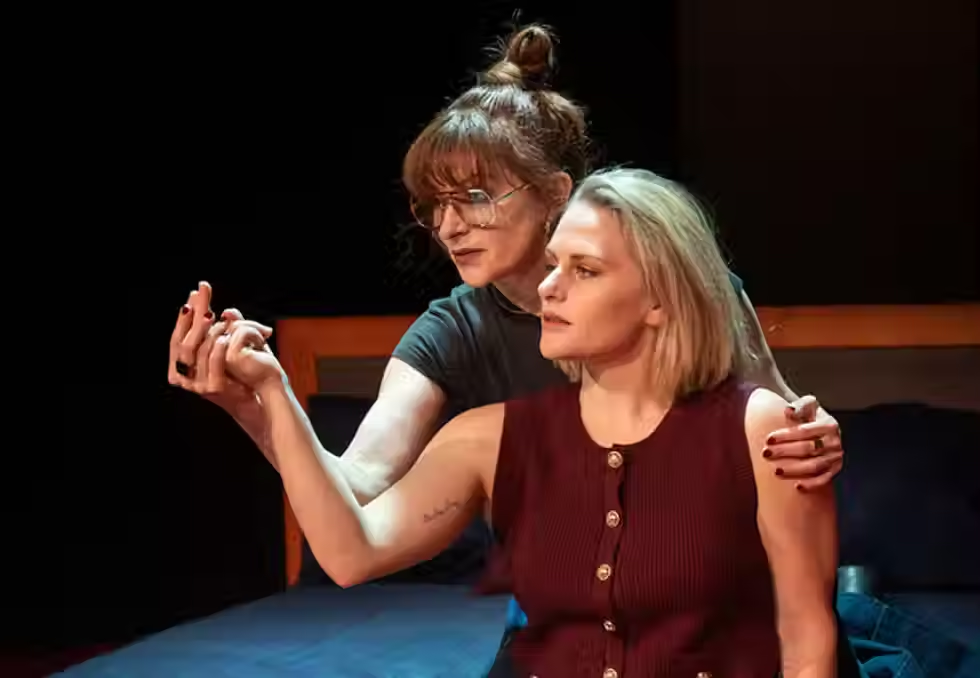
There’s a famous saying that if there’s a gun in a play, it better go off. It’s a kind of promise of drama. And it creates a kind of inevitable, unavoidable sense of foreboding. We know what will happen, just not how. Even before actors take the stage in The Slide is the Negative, a new play by Jake Shore, as a collaboration between Axial Theatre, JCS Theater Co. and Oberon Theatre Ensemble, we see a large bed at the center of the stage.
I was going to say we see that bed before the play “begins” at the Chain Theatre, but the truth is the play begins with the silence of an empty bed and bottles on dressers on the sides of the stage. That set’s promise of intimacy, and the bed as battleground, a boxing ring as well as a place to engage in and exchange intimacy, is one that is delivered in a show that presents intense, realistic dialogue, driven characters and a taut dramatic structure and sexual tension. There's some of Sam Shepard's intimate, exciting passion here in Jake Shore's own deft way of presenting character, dialogue and drama that kept the audience not only on the edge of their seats, but watching, worrying and wondering what will happen next to these characters.
A well-acted and directed play, being presented at The Chain Theatre, The Slide is The Negative is not just new, as in being first performed, but truly a new script, story and show. It tells or shows the story of Anne (Sophie Moshofsky) who is photographed naked, physically as well as emotionally, by Kelly (Cady McClain), a close friend and at least one time lover. The play, about one woman blatantly betraying another, plays with couple combinations in a kind of sexual merry go round where marriage is only one way of combining. It is also about art, how during an intimate moment, Kelly exploits that intimacy to create a public piece of art for personal gain, about breaking borders and boundaries, betrayal, and what we will do to each other in the name of “naked” ambition, artist or not. We get a play not just about nudity, but the naked truth, how we deal with an opportunity at someone else's expense.
Whether or not every character in this play has an open relationship, they will all open up or at least find sexual pleasure, or power, with each other. Barry (Brad Fryman) sleeps with his wife and best friend’s wife. They are artists, adventurers, trying new things. Joe (Ryan Tramont) is the cuckold, the man whose wife finds excitement outside the marriage, although he eventually tries this extra-curricular excitement as well. Even though he plays a lawyer, not an artist, he cheats as well beyond court, as everybody decides to draw out of the lines. We hear he’s worth half a billion, which is a kind of easy, convenient number that feels dishonest and exaggerated, but money or possession is his source of power. The characters’ souls, however, speak in a world where we are watching through a keyhole. This isn’t what the butler saw, but what the photographer, also a lover, saw. While so many of our own conversations are conventional and superficial, not revealing character, but taking up time, the dialogue here is where the true nakedness of each soul is revealed. No small talk, this is big, bold talk.
This photo or slide, taken of a menage a trois, rewarding McClain’s Kelly for her courage and exploitation, attracts attention and gets her an exhibit at a well known gallery known as the Link. It’s a deal with the devil, which art can be, as the artist as vampire sacrifices others to advance. Dig deep, but make sure you aren't digging someone's grave. That physical nakedness is matched by an emotional nakedness in this play that follows consequences, amid a quicksand of shifting intimacy. Art often is rewarded for risk, but things get complicated when it’s someone else’s risk. This isn’t treated, at first, as a crime, but an emotional violation. It might be better to have a clearer way to show that naked photo doesn’t violate privacy, legally, by exposing nudity. But the world is rife with examples of times when that has happened. Marilyn Monroe was photographed naked early on, although she consented. In The Slide is the Negative, we find out that Anne didn’t realize she was being photographed. It might simplify things if she did know about it at the time, thereby giving a kind of consent or assent, but believing that would be kept private.

Everybody basically sleeps with everybody in this world where people seek physical touch as a substitute for emotional connection, novelty to replace banality, sex as a kind of accomplishment and passion as well as possession. And this play works on several levels, first simply as a plot as we see how one friend succeeds by exposing another friend. Just as Shepard wrote westerns, this is a kind of sexual western, an exciting show to watch as the cast lets go of the walls of the swimming pool or rather dives in. They are emotionally naked on stage, letting go of the rafts that keep us floating in reality’s ocean, always about to drown. The show opens with high drama and doesn’t really let go. We know the ending right away, but have no idea how we’ll get there as we navigate through a dangerous labyrinthe of betrayal.
We hear early on that that Kelly’s photograph, by exposing Anne’s body, is a hit. What would we do, who would we hurt, for success? Is it the photographer’s art on display or the subject’s body or expression? John Guare’s most famous play, “Six Degrees of Separation,” is about David Hampton, a man who suffered and never made a penny from his exploits. Guare exploited someone who died poor and of AIDS. Artists all the time build their careers on others’ bodies and biographies. So yes this is about a photographer, but it’s also about art and writing. Rather than being in the moment, Kelly captures a moment and then markets it. When you dissect a frog to understand it, you kill it. She dissects and destroys her relationship with Anne, or could easily do that. That bed, then, becomes not just a place of passion, but a sacrificial altar as in ancient times when people were sacrificed to the gods, in this case for superficial success.
The two women in a way pine for the same success as their male spouses. Kelly played by Cady McClain finds the only way to do it is by exploiting Anne’s body and she does so eagerly, whether by sleeping with or exposing her.
Sex in this play, and sometimes in life, is really about power as much as passion. But then that's a big part of what theater, as well as relationsihps, can be about. When McClain as Kelly tells Moshofsky’s Anne about the photo, Anne asks to see it. McClain replies she will show her the photograph, but only when she chooses. McClain is intense, aggressive, but gentle, half angel and half devil, older than Moshofsky, whose body her character exploits. Moshofsky is confident and indignant, angry and desperate. Ryan Tramont is at once a victim and a villain, as well as simply human, sleepingi when he gets drunk, then strategizing, pacing as if he has his own plan. Brad Fryman takes a precious glee in what is going on, at once exploited and enjoying being exploited with a little bit of the glimmer that Philip Seymour Hoffman brought to his performances. The stage is a virtual chemistry class when it comes to chemistry between performers.
Sexuality becomes not just about pleasure here, but a way to reveal and compromise people. While we don’t see the actual photograph, we see the moment that is photographed. It migh be nice if that moment stopped time for a second, frozen forever, but we do see it go from ephemeral to permanent. It’s really not simply about a photograph, not just about the body, not just about beauty, but how writers, as well as photographers, cannibalize the lives of those around them, revealing not just themselves, but loved ones. They seek to sell not just their souls, but others’. The difference is in writing, it’s possible to disguise a soul, but a physical image is what it is. While we all value privacy, nakedness somehow gives ourselves away. Vampires sacrifice others, not themselves, as writers and photographers can do. Our body once photographed no longer belongs only to us. Ironically at this show about how a photograph exploits another person, audience members are told to leave their phones in sealed envelopes, so they won’t then potentially try to exploit those actors who briefly are naked on stage.
The horror and exploitation increases, becoming cruel, as we find characters taking revenge on each other. Escalation continues, becoming brutal, if off stage. The sound of the barking dogs reminds us that, as we're told, we are all animals and the characters, stripped of civilization, behave that way, physically fighting. Sam Shepard plays mix realism with a kind of surreal elevation as dramas escalate. This play is powerful, passionate and fueled by intimacy going far beyond a naked moment or two. I liked the fact that it shows sexual energy, not just passion, that women talk with one another about sexuality. This isn't just about having sex, but thinking and talking about sex. Everybody will betray everybody by the time the night is over, but here each Judas experiences a sense of joy before the sorrow of destruction. How did Judas feel after one of the most famous betrayals in history? We do see some nudity here, but to me at least, it’s not about that at all. When Allen Ginsberg was asked what nakedness meant to him after writing Naked Lunch, I believe he just stripped. Physical nakedness is a kind of honesty, or it can be. Clothes are camouflage, hiding us. Once you remove those, there’s really nothing more to say. We also wear words as camouflage, naked in our silence.
People have said that to write powerful things, it helps to start with a powerful subject matter. Melville or at least Ahab chases a whale, a big fish, in Moby Dick. Jake Shore fishes for and finds emotional whales. Director Paul Smithyman strikes the right note when it comes to realism and fantasy, sexuality and a sense of something sinister, passion and pain in a play where actors deliver powerful performances. Characters get in each other’s face, draw close and become dangerous. What personal space? The fights, choreographed by Judy Lewis Ockler, are brief but as well staged as a ballet. The cast, filled with actors who appeared in another Oberon Theatre production, seem to trust each other. If they are acrobats, we watch them sail through the air, confident that they will be caught by their counterparts. If you like to see theater as a tightrope walked by daring actors with a dangerous abyss all around, that’s what’s here in a drama where words bear so much weight they could nearly make the stage sag beneath the sheer stength of performances.
Smithyman’s set design and Yang Yu’s lighting create a beautiful, artistic, but dangerous world. The blue bed bathed in crimson light somehow seems covered with blood. That tiny slide appears toward the end, stolen and returned, but by then it is too late. Something seen can’t be unseen. Damage can't be undone. The physical exposure, a kind of violence, leads to physical violence. Some people say that photography steals a piece of our soul. So does writing, but in reality it really shares it. Jake Shore is a gifted writer whose work deserves more productions. He writes hard hitting plays that are brave in that they deal with sensitive subjects. The Slide is the Negative (and it is negative as an exploitation) is a brave, intimate, intense play. I wouldn’t call it shocking, but I did look at audience members during the show. For people who see theater as a staid trotting out of superficial stories to entertain, this is something more. The stillness in the silence here is something to see as well as the dialogue, the expression and the emotion as well as the conversation. The actors looked intense, but when I looked at the audience for a moment, I saw a single group seeming not to move, and not to blink, frozen like an image in a slide as they watched. When actors are intense, that’s a good play. When audience members watch with this kind of intensity, it’s a great one.


Cool show!